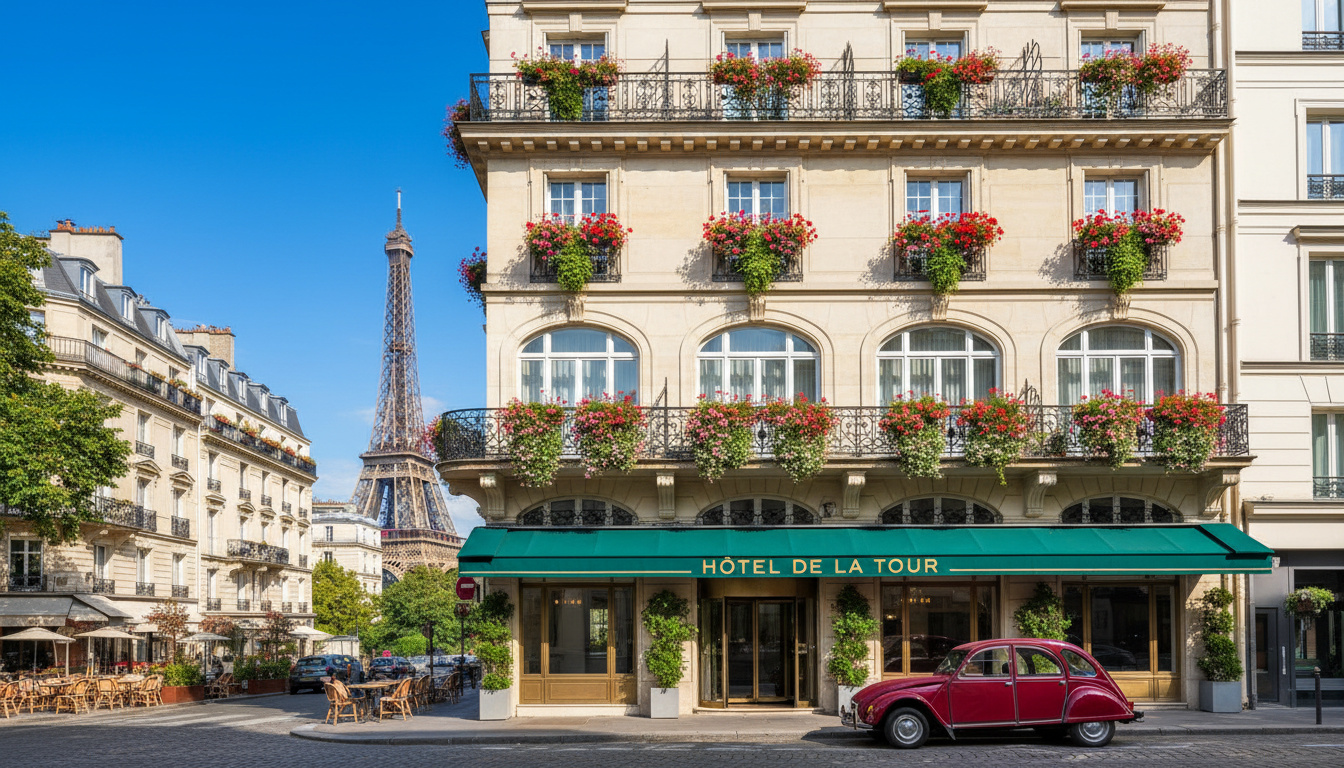
The Paris hotel landscape has transformed dramatically over the past decade, moving beyond the classic Haussmannian grand dames to embrace boutique design houses, converted industrial spaces, and micro-hotels that pack character into every square meter. Whether you’re seeking a palace-grade experience overlooking the Tuileries or a hidden courtyard gem in the Marais, understanding the city’s distinct arrondissements and pricing rhythms separates a memorable stay from a logistical headache.

Sjekk priser og tilgjengelighet
Se oppdaterte priser på Booking.com. Mange steder har gratis avbestilling.
Rask bestilling • Trygg betaling
Curated Stays: Four Distinct Experiences
Le Meurice remains the definitive address for First Arrondissement opulence, its Philippe Starck-designed interiors balancing 18th-century aristocratic codes with surrealist flourishes. The hotel overlooks the Tuileries Garden, placing the Louvre and Orsay within ten minutes’ walk.
Hôtel Costes continues to define Left Bank attitude, its Rue Saint-Honoré location masking a courtyard that feels worlds away from the surrounding luxury retail. Despite the see-and-scene reputation, the rooms deliver genuine comfort, with heavy brocade curtains and marble bathrooms that justify the premium.
Generator Paris disrupted the market when it opened near Canal Saint-Martin, converting a 1960s office block into a design-forward hostel-hotel hybrid. Private rooms offer rainfall showers and custom millwork at rates rarely seen below the 10th arrondissement.
Hôtel Jules & Jim exemplifies the Haut Marais renaissance, its three restored 18th-century buildings centering on a cobblestoned courtyard where guests breakfast beneath century-old wisteria. The stripped-back aesthetic—exposed beams, concrete floors, vintage Scandinavian furniture—attracts a creative crowd that prefers the 3rd arrondissement’s quieter streets to Saint-Germain’s bustle.
Market Insights: Where Paris is Sleeping Now
The post-pandemic shift has permanently altered booking patterns. While the 1st, 6th, and 8th arrondissements maintain their grip on luxury occupancy rates, travelers increasingly prioritize the 10th, 11th, and 20th for extended stays, seeking neighborhood authenticity over monument proximity. According to Paris Convention and Visitors Bureau data, average stays in peripheral districts have lengthened from 2.3 nights to 4.1 nights since 2022.
This decentralization has triggered a wave of restaurant openings in formerly overlooked quarters. The Canal Saint-Martin and Belleville corridors now rival the Marais for dining density, making hotels in these zip codes surprisingly strategic for food-focused visitors.
Arrondissement Comparison
| District | Character | Average Nightly Rate (€) | Best For |
|---|---|---|---|
| 1st (Louvre) | Monument-core, high luxury | 650–1,200 | First-time visitors |
| 3rd/4th (Marais) | Historic Jewish quarter, LGBTQ+ hub | 220–450 | Culture shoppers |
| 6th (Saint-Germain) | Literary heritage, café society | 380–850 | Boulevardier romance |
| 10th (Canal Saint-Martin) | Village atmosphere, young creative | 140–280 | Extended stays |
| 16th (Trocadéro) | Residential calm, Eiffel views | 320–600 | Families |
Neighborhood Deep Dive
Saint-Germain-des-Prés seduces with its literary ghosts and polished limestone façades, but rates here reflect the neighborhood’s status as a hedge-fund sanctuary as much as its cultural pedigree. The 7th arrondissement offers similar grandeur with slightly more breathing room, particularly around Rue Cler’s market street.
The Le Meurice stands as the 1st arrondissement’s anchor property, though savvy travelers increasingly cross the Seine to the 7th, where Shangri-La Paris delivers Eiffel Tower views without the Champs-Élysées chaos. Both properties sit within the “Palace” designation, France’s official classification above five stars.
For those prioritizing food over views, the 11th arrondissement’s Oberkampf and Voltaire quarters hide family-run hotels within stumbling distance of natural wine bars and neo-bistros. These properties often lack elevators—authentic Parisian charm that becomes less charming on the fourth floor with luggage.
When to Book: A Seasonal Framework
January and February offer genuine bargains, with luxury properties dropping rates by 30–40% below summer peaks. The trade-off is early darkness and intermittent strikes, though museum crowds thin dramatically.
March through May demands advance planning; Paris Fashion Week and the French Open create compression pricing that affects even budget properties. September and October replicate spring’s demand curve, while December’s holiday lights justify premium rates for the atmospheric payoffs.
Understanding the Fine Print
French hotel star ratings differ significantly from American or British systems. A Parisian three-star property may offer comparable amenities to a North American four-star, while “Palace” designation—held by only twelve properties—indicates exceptional historical significance, service ratios, and concierge capabilities beyond standard luxury markers.
Breakfast inclusion varies wildly. Chains typically bundle it; independents often charge €18–35 for continental service. Given the abundance of local bakeries, the a-la-carte approach frequently wins on both cost and quality unless the hotel offers a genuinely spectacular spread.
Market Analysis: Post-Olympics Reality
The 2024 Summer Olympics accelerated infrastructure improvements—particularly in the eastern arrondissements where Metro Line 14 extensions improved connectivity—but failed to trigger the sustained rate inflation many anticipated. Financial Times analysis shows that September 2024 actually saw year-over-year rate declines in the luxury sector as Olympic inventory flooded back into the market.
Boutique properties under fifty rooms have proven most resilient, their fixed costs allowing operational flexibility that larger palace hotels lack. The trend toward “aparthotel” concepts—hybrid extended-stay products with kitchenettes and weekly housekeeping—continues to capture market share from traditional three-star properties.
Guest Perspectives
“We stayed at a tiny fourteen-room property near Place des Vosges expecting compromise. Instead, we got a concierge who remembered our coffee preferences and directed us to a Marais wine shop we’d never have found on TripAdvisor.”
— Copenhagen design team, March 2024
“The 16th arrondissement felt too quiet until we realized we could reach the Luxembourg Gardens in twelve minutes and sleep without scooter noise. Sacrificing ‘central’ for ‘peaceful’ was the right call with jet lag.”
— Toronto family, June 2024
At a Glance
Paris rewards the prepared traveler with accommodation options that match specific temperaments: the 1st and 6th for classicists, the 3rd and 4th for fashion and history enthusiasts, the 10th and 11th for culinary explorers. Prices fluctuate dramatically by season, but value persists year-round for those willing to trade elevator access for location or square footage for character. Whether booking a palace suite or a converted atelier, the essential strategy remains identical—prioritize proximity to a Metro station over specific monuments, and remember that Paris’s greatest luxury is the ability to walk home from dinner along the Seine.
Frequently Asked Questions
Which arrondissement is best for first-time visitors?
The 4th (Marais) or 6th (Saint-Germain) offer optimal balances of walkability, central location, and neighborhood atmosphere. Both provide easy access to major museums without the sterile hotel corridors of the 1st arrondissement, while maintaining safer evening environments than peripheral districts.
Are Paris hotel rooms really that small?
Yes, frequently. Legal minimums allow single rooms as compact as 9 square meters. Expect 15–20 square meters for standard doubles in buildings predating the 20th century. If space matters, seek properties built after 1960 or consider the 16th arrondissement, where wider boulevards allowed larger building footprints.
Is it better to book directly with the hotel?
Direct bookings often secure better room placements, late checkout, and occasionally breakfast inclusion. However, during high-demand periods (May, September, December), third-party platforms sometimes block inventory that hotels cannot match. For your complete Paris city guide, compare rates across channels before committing.
How do I avoid hidden charges?
City tax (taxe de séjour) adds €1–5 nightly per person depending on hotel class, always charged separately from the room rate. Additionally, verify whether quoted rates include VAT (TTC) or exclude it (HT). Unlike London hotels, Paris properties rarely include breakfast unless explicitly stated.
Klar for å bestille?
Sammenlign anmeldelser, beliggenhet og pris – og finn det som passer deg best.
Anmeldelser • Kart • Tilbud